Meta Description: Master Omnichannel Marketing with AI Orchestration. Learn how AI synchronizes customer journeys across channels for maximum ROI. Discover the future of CX today!
In the rapidly evolving digital landscape of 2026, the boundary between physical and digital storefronts has nearly vanished. Customers no longer “go online”; they live in a persistent state of connectivity. For brands, this shift means that being present on multiple platforms—multi-channel—is no longer enough. The gold standard has shifted to Omnichannel Marketing with AI Orchestration.
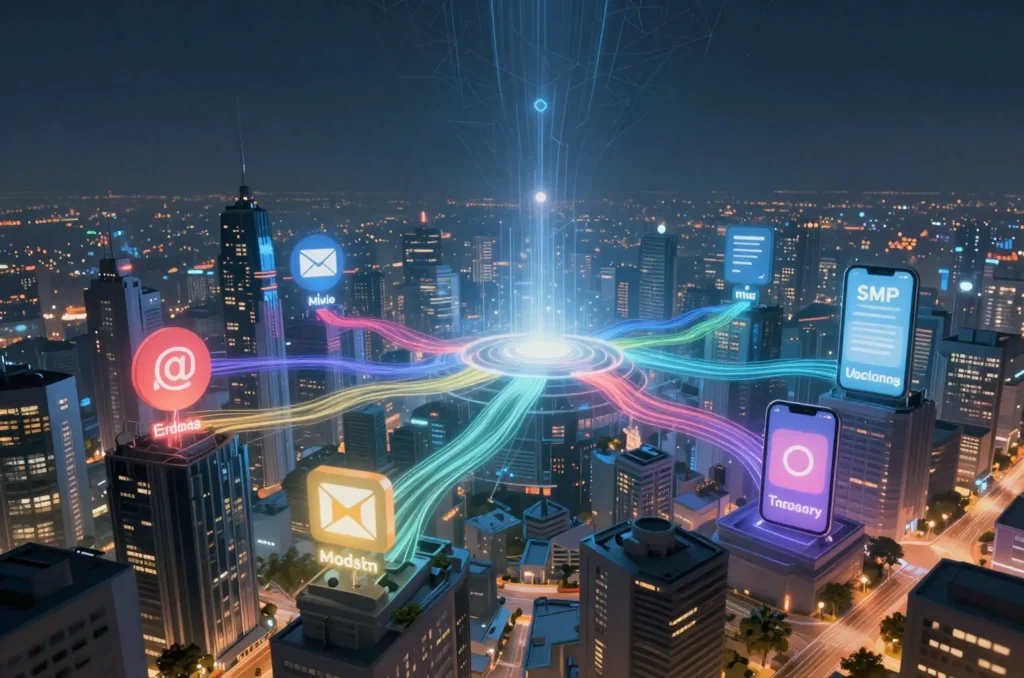
But what does “orchestration” actually mean in a world saturated with data? It is the difference between a high school band playing out of tune and a world-class symphony led by a master conductor. In this scenario, Artificial Intelligence is the conductor, ensuring every touchpoint—from a social media ad to an in-store kiosk—whispers the same personalized message to the consumer.
This guide dives deep into how AI is revolutionizing the omnichannel experience, moving beyond simple automation into the realm of predictive, real-time journey management.
1. What is AI Orchestration in Omnichannel Marketing?
To understand AI orchestration, we must first distinguish it from simple multi-channel marketing. Multi-channel is about being everywhere. Omnichannel is about being everywhere, together. AI orchestration is the engine that makes “together” possible.
The Shift from Static to Dynamic Journeys
Traditionally, marketers created “if-then” logic gates. If a user abandons a cart, send an email. AI orchestration ignores these rigid paths. Instead, it uses machine learning to analyze trillions of data points in milliseconds to decide the Next Best Action (NBA).
- Data Integration: AI pulls information from CRMs, social media APIs, and offline POS systems.
- Real-Time Processing: It doesn’t wait for a weekly report; it adjusts the customer’s feed while they are still scrolling.
- Contextual Relevance: It knows that a customer browsing umbrellas during a rainstorm in London needs a different prompt than someone in sunny Dubai.
Expert Insight: “Orchestration isn’t about more messages; it’s about the right message. In 2026, the most successful brands are those that use AI to know when to stay silent just as much as when to speak.” — Elena Vance, Senior Data Strategist.
2. Key Components of AI-Driven Omnichannel Strategy
Successful AI orchestration relies on three foundational pillars. Without these, your AI is simply a powerful engine without a steering wheel.
Unified Customer Profile (The Golden Record)
AI cannot orchestrate what it cannot see. Brands must move away from data silos. A Unified Customer Profile (UCP) aggregates identity data, behavioral patterns, and purchase history into a single source of truth.
Predictive Analytics and Propensity Modeling
AI doesn’t just look at what happened; it predicts what will happen. By using propensity models, AI can determine the likelihood of a customer churning or making a high-value purchase.
Creative Intelligence
In 2026, AI also handles the “what.” Generative AI tools now create thousands of versions of an ad, tailoring the visual style and tone of voice to match the specific psychological profile of the viewer in real-time.
3. How AI Orchestration Solves the “Fragmented Journey” Problem
The modern customer journey is a “messy middle.” A user might see an influencer’s post on Instagram, research the product on Reddit, compare prices via a voice assistant, and finally buy it through a smart mirror.
Eliminating Friction with Cross-Channel Continuity
Have you ever clicked an ad for a product you just bought? That is a failure of orchestration. AI prevents this by:
- Instant Suppressing: Automatically removing customers from “acquisition” funnels once they move to “retention.”
- Cart Persistence: Ensuring that items added on a mobile app are immediately visible when the user logs in via a desktop or a smart TV.
- Bridge to Physical: Sending a push notification with a personalized discount code when a high-value customer walks within 100 meters of a physical store location.
4. Comparing Approaches: Manual vs. AI-Orchestrated Omnichannel
| Feature | Manual/Rule-Based | AI-Orchestrated (2026) |
| Segmentation | Static (Age, Location) | Hyper-dynamic (Behavior, Intent) |
| Response Time | Scheduled/Delayed | Real-time (Milliseconds) |
| Scalability | Limited by human bandwidth | Infinite across millions of users |
| Optimization | A/B Testing (Slow) | Multi-armed Bandit Testing (Instant) |
| Content | One-to-many | One-to-one (Generative) |
5. The Role of E-E-A-T in AI Marketing
As AI takes over the execution, the human element becomes the guardian of Experience, Expertise, Authoritativeness, and Trustworthiness (E-E-A-T).
- Experience: AI provides the data, but humans provide the “why.” Use AI to identify trends, but use human experts to craft the brand narrative.
- Trustworthiness: With AI-driven marketing comes the responsibility of data privacy. Brands must be transparent about how AI uses customer data. According to Gartner, 80% of consumers in 2026 choose brands based on their data ethics.
- Authority: Link your AI-driven insights to reputable third-party studies. For instance, citing the Harvard Business Review on customer centricity adds weight to your automated strategies.
6. Implementing AI Orchestration: A Step-by-Step Guide
If you are looking to transition into a fully orchestrated model, follow these steps:
- Audit Your Stack: Ensure your ESP, CRM, and Social tools have open APIs.
- Define Your North Star Metric: Is it Customer Lifetime Value (CLV) or immediate conversion? AI needs a clear goal to optimize effectively.
- Start with “Trigger” Moments: Identify the 3 most critical points in your funnel (e.g., welcome series, cart abandonment, re-engagement).
- Deploy a CDP: Use a Customer Data Platform to act as the “brain” for your AI conductor.
- Test and Refine: Use AI to run 1,000 micro-tests simultaneously rather than one big A/B test.
7. The “Hidden Factor”: Emotional AI in 2026
One unique perspective often overlooked by competitors is Sentiment Orchestration. AI in 2026 doesn’t just track clicks; it analyzes the tone of customer service interactions and social comments.
If the AI detects frustration in a customer’s chat transcript, it can instantly override a “salesy” promotional email scheduled for that evening and replace it with a “How can we help?” message. This level of empathy at scale is the true frontier of omnichannel success.
8. Frequently Asked Questions (FAQ)
What is the difference between marketing automation and AI orchestration?
Automation follows a pre-set script (e.g., “send an email after 2 days”). Orchestration is fluid; it decides the best channel and time based on the user’s current behavior, which might change every second.
Is AI orchestration expensive for small businesses?
While enterprise tools are costly, many SaaS platforms now offer “AI-lite” orchestration features. The ROI usually justifies the cost by reducing wasted ad spend on irrelevant impressions.
How does AI orchestration handle privacy regulations like GDPR?
Modern AI orchestration tools are “Privacy by Design.” They use federated learning or zero-knowledge proofs to personalize experiences without ever seeing the raw PII (Personally Identifiable Information) of the user.
9. Conclusion: The Future is Orchestrated
Omnichannel marketing with AI orchestration is no longer a luxury—it is a survival requirement. By synchronizing your channels, you move from shouting into a megaphone to having a meaningful, 1-on-1 conversation with every single customer.
The brands that win in 2026 won’t be those with the biggest budgets, but those with the smartest “conductors.” Stop managing channels and start orchestrating experiences.
Ready to revolutionize your digital presence? Start by auditing your customer data silos today and let AI lead the way to a seamless future.